Sunday, July 13, 2014

The real meaning of Emmanuel.

John 8:25 - 29  NASB  New American Standard Bible
25 So they were saying to Him, “Who are You?” Jesus said to them, “What have I been saying to you from the beginning?
26 I have many things to speak and to judge concerning you, but He who sent Me is true; and the things which I heard from Him, these I speak to the world.”
27 They did not realize that He had been speaking to them about the Father.
28 So Jesus said, “When you lift up the Son of Man, then you will know that I am He, and I do nothing on My own initiative, but I speak these things as the Father taught Me.
29 And He who sent Me is with Me; He has not left Me alone, for I always do the things that are pleasing to Him.”

The real meaning of Emmanuel or "God With Us" can be seen in the words of our Lord Iesus the Anointed in John 8:29, when he declared that the One who sent him is with him.

Who is the One who sent our Lord? Who is "He" who sent the Lord Iesus? Verse 27 says Iesus was speaking to them about the Father, the Only True God (John 17:3).

Yes the One who sent our Lord, who is with him, is our Father in heaven. He is our One True God. Our God is with His Anointed Iesus. When the people saw the Iesus, they saw God with him.

This is the true meaning of Emmanuel, God with us.

Matthew 1:22 - 23  NASB  New American Standard Bible
22 Now all this took place so that what was spoken by the Lord through the prophet would be fulfilled:
23 “Behold, the virgin will conceive and give birth to a Son, and they shall name Him Immanuel,” which translated means, “God with us.”
Isaiah 7:14  NASB  New American Standard Bible
Therefore the Lord Himself will give you a sign: Behold, the virgin will conceive and give birth to a son, and she will name Him Immanuel.

Moses' unexpected song.

A short note about Deuteronomy 32: 1 - 43

Deuteronomy 32:15-18New American Standard Bible (NASB)

15 But [a]Jeshurun grew fat and kicked—
You are grown fat, thick, and sleek—
Then he forsook God who made him,
And scorned the Rock of his salvation.
16 They made Him jealous with strange gods;
With abominations they provoked Him to anger.
17 They sacrificed to demons who were not God,
To gods whom they have not known,
New gods who came lately,
Whom your fathers did not dread.
18 “You neglected the Rock who begot you,
And forgot the God who gave you birth.

This is an unexpected song about Israel's impending disobedience. This song of Moses is recorded at the end of his long discourse to the people of Israel, after he had appointed Joshua (Yeshua) to succeed him as the chosen one of Israel.

What does UNTIL mean in this verse?

(This note was written on Sunday 7-7-2013)

Hebrews 9: 8 -10 NASB
The Holy Spirit is signifying this, that the way into the holy place has not yet been disclosed while the outer tabernacle is still standing, which is a symbol for the present time. Accordingly both gifts and sacrifices are offered which cannot make the worshiper perfect in conscience, since they relate only to food and drink and various washings, regulations for the body imposed until a time of reformation.

The above verses explain to us that the worship arrangements of the OT Tabernable - the "outer" tabernacle - were meant to be an illustration that pointed to the present time.

Those offerings and animal sacrifices cannot make the hearts of worshippers perfect. For example Isaiah prophesied harshly against the sinfulness of Israel in Isaiah 1: 11 - 15, a people who offered sacrifices of sheep, bulls and fine animals (v11), saying that their hands were covered with blood (v15)!

Such sacrifices involve only food, drinks and purification rites. They are outward rules which apply only UNTIL the (present) time when the new order is established by God.

Today, I ponder over the word UNTIL and I wonder what it really means. Does it mean that the food offerings, drink offerings and acts of purification commanded by Moses in scripture no longer have to be observed anymore? Does it also imply that God will no longer meet worshippers in any man-made temple in Jerusalem ever again?

Naaman's washing in the River Jordan.

(These notes were originally written in my note pad on Sunday 7-7-2013)

Text: 2 Kings 5: 1 - 14

Naaman's washing in the River Jordan may be seen as a "type" of baptism in today's kingdom of God. I'd like to find out whether such washing was already a common practice in those ancient days, perhaps not unlike the practice of "mikveh" (baptism) among the Jews.

In 5:11, we read of Naaman's anger at not being treated with more dramatic actions but merely being told to go immerse himself in the River Jordan. This aspect of Naaman's washing can be a type of today's cleansing from sin by mikveh or baptism in water.

Going on to 5:12, Naaman's criticism of the inferiority of the River Jordan compared to "better" rivers like Abanah and Pharpar back home in Damascus typifies today's simple act of calling on the name of Yeshua the Messiah during baptism, without any sensational or dramatic rituals, and without need for any grand building, elaborate vestments nor sacred instruments.

The conclusion to this brief observation amy be seen in 5:13, when Naaman's servants approached him and asked him something like,

"Can't you just wash yourself and be cured?"

Note that Naaman had to immerse himself. Nobody could do it for him. Certainly not Elisha the prophet. Also he had to immerse himself in a seemingly humble river called the Jordan. And furthermore Naaman had to immerse himself no less than seven times. Just a single immersion won't do.

Finally, note the significance of the prophet's name: Elisha. It means My God (Eli) saves (sha). This is typological of the name of our Messiah, Ye - shua or Yeho-sha (Yehovah saves).

Brothers and sisters in the Messiah. Have we washed ourselves in the Name of our Messiah "Yehovah saves"?

Saturday, July 12, 2014

Powerful preaching.

A devotion on Acts chapters 4 and 5. I wrote these notes two months ago, on 13-5-14 on a small piece of paper. Thought I should post it here tonight to share with all Brothers and Sisters in the Lord.

The early Apostles preached the resurrection of the Lord Iesous Christos (Yeshua the Messiah) with great power. (Acts 4:33)

Soon after that, in Acts 5: 29-32, Peter and the other apostles testified before the Sanhedrin. They
proclaimed that:

(a) God raised Yeshua from death,

(b) God exalted Yeshua to His right hand as Prince and Saviour,

(c) so that Yeshua may give repentance and forgiveness to the people of Israel.

(d) God has given his Spirit to those who obey him.

Such is the powerful preaching by the Apostles. God has raised the Messiah. God has exalted him to be Prince and Saviour. And last but not least, God has given the Holy Spirit to those who obey him.

Brothers and Sisters, let us obey God.

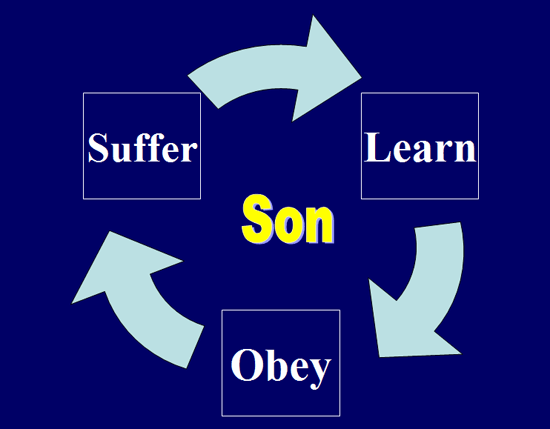
Although he was a son, he learned obedience.

Hebrews 5:8 NASB
"Although he was a son, he learned obedience through what he suffered."

Recently I have been pondering over the expression "a son" and have called to mind several instances of the use of "son of God" in the scriptures. After some further searching I came across the following list:

(1) Adam is the only person called "son of God" at the end of the long genealogy. (Luke 3:38)

(2) There was a time when "sons of God" married daughters of men and produced offspring of giants called Nephilim. Notice that the Nephilim were not called sons of God. (Genesis 6:2,4)

(3) Satan came along with "Sons of God" came to present themselves before YHWH on several occasions. (Job 1:6, 2:1) In these verses, the LXX renders "sons of God" as angels.

(4) The Psalmist calls on "sons of the mighty" to ascribe to YHWH glory and strength (Psalm 29:1)

(5) In another similar instance, the Psalmist asks who "in the skies" is comparable to YHWH? And who among the "sons of the mighty" is like YHWH? (Psalm 89:6)

(6) After casting three men into the furnace, Nebuchadnezzar was astonished by the appearance of a fourth person like a "son of the Gods" (Daniel 3:25)

I think there are other instances of "sons of God" being used in scripture which I have yet to come across. The list above nevertheless shows us one fact from scripture: that Adam and all the heavenly beings are called sons of God. The only characteristic I think can be attributed to them is that they are created by YHWH himself, in contrast to sons of men who are reproduced by being born (begotten) of human parents.

Whether Adam, or angels, or some other heavenly beings, "sons of God" or "sons of the mighty" appear to be created directly by of YHWH. It may be appropriate to say here that none of the sons of God mentioned in scripture were born or begotten.

Except one: he is Yeshua, a son of God who was brought about by being born (begotten) of a woman, Mary, when the power of the Most High overshadowed her (Luke 1:35).

Hence the term "only begotten" as used in the Gospel according to John.

My conclusion here is that Yeshua is a "son of God" just as Adam, and just as all the heavenly hosts are: including angels, cherubims, winged creatures etc. They are basically created to be "ministers and servants" of YHWH (Psalm 104:4).

The big difference is that Yeshua is the only "begotten" son of YHWH, born of a woman, died to atone for sin and was raised from the dead by YHWH on the third day to sit at His right hand. And, " Thus he became so far better than the angels as he has inherited a name superior to theirs." (Hebrews 1:4)

With such understanding, the phrase "though he was a son" in Hebrews 5:8 can be understood as "though he was one of God's created beings" (notice the indefinite article "a"), yet Yeshua learned obedience to God by sufferings and thereby he was made perfect.

Brothers and Sisters in the Lord Iesous Christos (Yeshua the Messiah), let us keep this word in our hearts:

"In the days of His flesh, He offered up both prayers and supplications with loud crying and tears to the One able to save Him [e]from death, and He [f]was heard because of His piety. Although He was a Son, He learned obedience from the things which He suffered. And having been made perfect, He became to all those who obey Him the source of eternal salvation, being designated by God as a high priest according to the order of Melchizedek." (Heb, 5: 7-10)

Sunday, May 11, 2014

Joshua son of Nun: type of Yeshua ben Elohim

Reading Joshua Chapter 1

Written in Wesley Methodist Church Kampar, Sunday 11May2014

A comparison of the role and authority of Joshua ben Nun in the Old Testament with that of the Master Yeshua ben Elohim (Iesous, Son of God) in the New Testament

(1) Those who Failed and Some who Remain

Joshua, in his commands to the officers of the people, reminded them of the words of Moshe, that YHWH their God is giving them rest and this land.
Joshua 1:10 - 11 NKJV
Then Joshua commanded the officers of the people, saying, 11 “Pass through the camp and command the people, saying, ‘Prepare provisions for yourselves, for within three days you will cross over this Jordan, to go in to possess the land which YHWH your God is giving you to possess.’”
Joshua 1:12 - 15
And to the Reubenites, the Gadites, and half the tribe of Manasseh Joshua spoke, saying,  “Remember the word which Moses the servant of the Lord commanded you, saying, ‘YHWH your God is giving you rest and is giving you this land.’ . . . But you shall pass before your brethren armed, all your mighty men of valor, and help them, until YHWH has given your brethren rest, . . .” 
The people of Israel, however, failed to receive nor enter into God's rest because of their disobedience. (See Psalm 95: 7 - 11, explained in Hebrews 3: 7 - 11)

Hebrews 4:6,9 tells us that "those" to whom it was first preached did not enter God's rest because of their disobedience and also it remains that "some" must enter it. Verse 9 says,
"There remains therefore a rest for the people of God"
Hebrews 4:10 goes on the elaborate that anyone (people of God) who have entered His rest will also have ceased from his own works, just as God Himself also rested from His work. (See genesis 2:2, quoted in Hebrews 4:4) on the seventh day of Creation.

Futhermore, Hebrews 4:11 warns us to be diligent to enter that rest (the rest of God) and to beware of falling in the same way of the Israelites who disobeyed.

(2) The commands of Joshua and the commands of Moshe

Joshua ben Nun was given all the authority of Moshe, and YHWH Elohim was to be with Joshua just as He was with Moshe. (see Joshua 1:7). The people of Israel promised to heed Joshua in the same way.

Of utmost importance, perhaps surprisingly, the people of Israel went on to affirm that whoever does not heed the words of Joshua's commands shall be put to death!

Concerning the commands in the Torah (Law), it is noted in Hebrews 10:28 that, on the testimony of two or three witnesses, anyone who rejected "Moshe's Law" dies without mercy.

It is clear from Joshua chapter One that the words of Joshua, like the words of Moshe, when uttered as a Command or Law, were to be obeyed by the people on pain of death.

(3) Obeying Yeshua and Obeying God

Likewise, just as the people of Israel obeyed Moshe, and subsequently Joshua, as prophets who gave commands from YHWH Elohim, and that disobeying them was disobeying God, today we are reminded to obey the commands of another Joshua: our Master Yeshua the Messiah (the Lord Iesous Christos) as the very commands of Elohim himself.

The Lord Iesous himself told his disciples in John 14:1, "you believe in God, believe also in me".

Again in John 14:21, the Lord Iesous said that anyone who keeps His commands will be loved by God his Father. In fact, the imperative, "keep my commandments" is uttered by our Lord Iesous three times in the Gospel according to St John:

John 14:15
If you love me, keep my commandments
John 14:21
He who has my commandments and keeps them, he it is who loves me . . .
John 15:10
If you keep my commandments, you will abide in my love

Summary

Joshua ben Nun was the Type (forerunner) of Yeshua ben Elohim (Iesous, Son of God) in the following ways

  1.  Joshua ben Nun took over from Moshe. Yeshua likewise takes over the role of being leader, our Messiah (Christos)
  2. Joshua ben Nun was given authority as God's prophet. His commands were to be obeyed just as Moshe's commands were obeyed, as God's commands. Likewise, the Master Yeshua's commands are to be obeyed as God's commands.
  3. Joshua's mission was to lead Israel into God's rest and into God's promised land. Likewise, Yeshua's ministry is to bring God's people into God's rest.

Conclusion

Brothers and Sisters, let us be diligent today, let us strive to enter the Rest ordained by God our Father in Heaven by keeping the commandments of our Master Yeshua the Messiah, (our Lord Iesous Christos).